How Long Do Solar Panels Last? What the Research Says
Quick answer
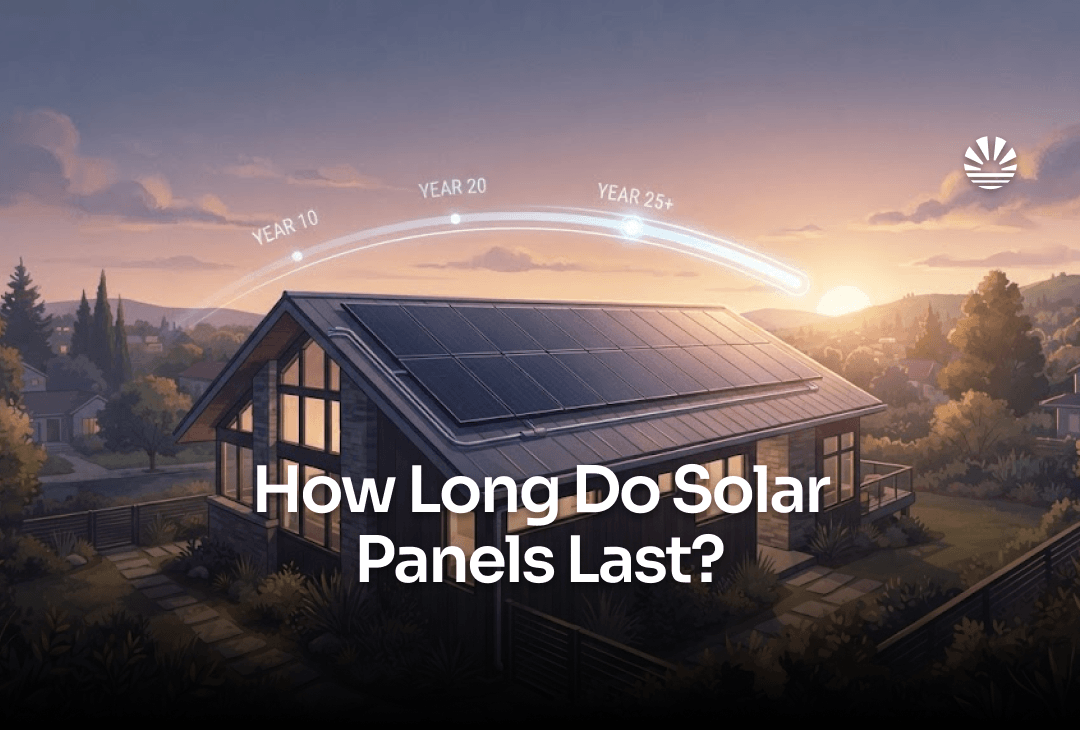
Quality solar panels commonly last 25 years or more. A major NREL review of nearly 2,000 measurements found panels lose a median of 0.5% of their output per year, so a panel still produces roughly 88% of its original output after 25 years. Inverters and batteries usually need replacing sooner than panels, so check each warranty separately.
Key takeaways
- NREL research found solar panels lose a median of about 0.5% of their output per year.
- At that rate, a panel still produces roughly 88% of its original output after 25 years.
- Performance warranties of 25 to 30 years are common, but read the brand's warranty document for the exact terms.
- Inverters and batteries usually need replacing before the panels do.
Solar is a long-term investment, so it's fair to ask how long it lasts. The good news is that quality panels keep working for decades. The other parts of your system have shorter lives, so it helps to know what to expect from each one.
Solar Panels Last 25 Years and Beyond
Solar panels don't suddenly stop working. They slowly produce a little less power each year.
This gradual loss is called degradation. The US National Renewable Energy Laboratory (NREL) reviewed nearly 2,000 measured degradation rates from panels around the world. It found a median loss of 0.5% per year, an average of 0.8% per year, and 78% of all results below 1% per year.
What 0.5% a year means for you
At 0.5% a year, your panels keep most of their output for a very long time.
- After 10 years: about 95% of original output
- After 25 years: about 88% of original output
Heat and humidity matter
Panels in hot, humid climates tend to degrade a bit faster.
The NREL review found higher degradation in hot climates. That's one more reason to choose quality panels and a careful installation in the Philippines.
Understanding Solar Panel Warranties
Most panels come with two separate warranties.
- Product warranty: covers defects in the panel's materials and manufacturing.
- Performance warranty: guarantees the panel will still produce a minimum share of its rated output after a set number of years. Warranties of 25 to 30 years are common.
Always read the manufacturer's warranty document for the exact terms, and ask your installer what their own workmanship warranty covers.
Inverters Usually Need Replacing Sooner
The inverter is usually the first major part to need replacing.
It contains electronics that wear out faster than panels, so plan to replace it at least once during your panels' life. Keeping it shaded and well ventilated helps it last longer.
Batteries Wear Out With Use
A battery's life depends on how often and how deeply it is charged and discharged, and on its temperature.
LiFePO4 (lithium iron phosphate) batteries generally last far longer than lead-acid batteries. Compare them in LiFePO4 vs Lead-Acid Batteries for Solar.
What Shortens a System's Life
Most early problems come from installation and environment, not the panels themselves.
- Poor installation: loose connectors, water entering junction boxes, or roof penetrations that weren't sealed properly
- Heat: panels mounted with no airflow underneath, or inverters and batteries placed in hot spots
- Physical damage: flying debris during typhoons, or people walking on panels
- Surges and lightning: systems without proper surge protection and grounding
- Salt air: homes near the coast need corrosion-resistant mounting and salt-mist-tested panels
How to Help Your System Last
A few simple habits protect your investment.
Check your monitoring app regularly, clean the panels gently when dust builds up, and have the system checked after strong storms. Read Can Solar Panels Survive a Typhoon? for a simple checklist.
Want a system built to last? Request a free site assessment.
Source: Jordan, D. C. and Kurtz, S. R., "Photovoltaic Degradation Rates: An Analytical Review," Progress in Photovoltaics, 2013 (NREL).