Net Metering in the Philippines: What Changed in 2025
Quick answer
Net metering lets homes and businesses with solar systems up to 100 kW export extra power to the grid in exchange for bill credits. Under rules the ERC amended in 2025, unused credits can now be banked and rolled over to future bills and transferred to a new owner if the property is sold. Homeowners apply for it with their own utility.
Key takeaways
- Net metering lets solar systems up to 100 kW export extra power to the grid in exchange for bill credits.
- Under the 2025 ERC rules, unused credits roll over to future bills and can transfer to a new owner, and the REC meter is now optional.
- Exported power is credited at your utility's generation cost, which is lower than the retail rate you pay.
- The homeowner applies with their own utility, and requirements vary by utility.
On sunny days, your solar panels may produce more power than your home uses. Net metering lets you send that extra power to the grid and get credits on your electric bill. Here's how it works and what changed in 2025.
How Net Metering Works
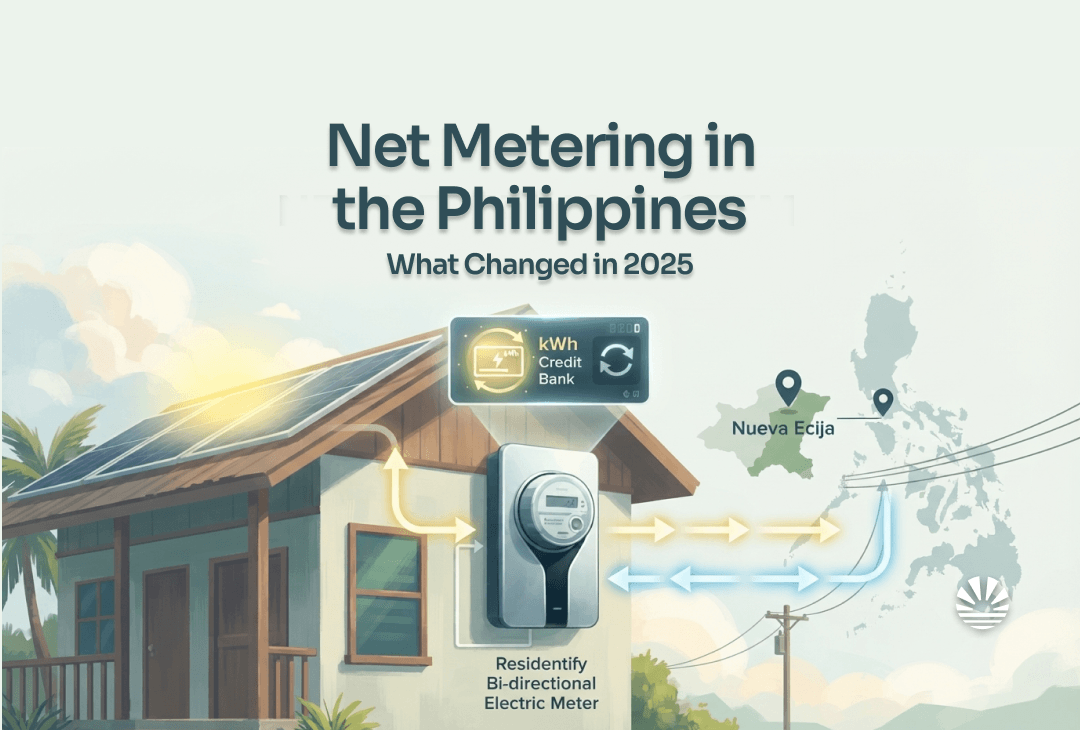
Net metering uses a bi-directional meter that records power flowing both ways.
The meter tracks the electricity you buy from the grid and the electricity you export to it. Your exported power earns credits that reduce your bill. The program is based on the Renewable Energy Act of 2008 (Republic Act 9513) and rules set by the Energy Regulatory Commission (ERC).
Who Can Apply?
Net metering covers renewable energy systems up to 100 kW.
That includes most home and small business solar systems. The rules apply to distribution utilities, including Meralco and electric cooperatives.
What Changed in 2025
In August 2025, the ERC amended the net-metering rules to make the program easier to use.
- Credits roll over: unused credits can be banked and carried over to future bills.
- Credits can transfer: if you sell the property, the credits can go to the new owner.
- Simpler metering: the separate Renewable Energy Certificate (REC) meter is now optional.
- More transparency: utilities must publish their net-metering program, application process and grid hosting capacity every quarter.
According to the Department of Energy, 17,175 electricity users were registered under net metering as of May 2025, with a combined capacity of 157 MW.
How Much Is Exported Power Worth?
Exported power is credited at your utility's generation cost, not the full retail rate.
That means each kWh you export is worth much less than each kWh you buy. For example, NEECO II Area 1 credited exported power at ₱3.5302 per kWh in March 2026, while retail rates in the province were around ₱11 to ₱15 per kWh. See Electricity in Nueva Ecija for current rates.
This is why a well-designed system is sized so you use most of your solar power at home, where each kWh saves you the full retail rate.
How to Apply
The homeowner applies for net metering directly with their own utility.
Requirements and timelines differ between utilities, so ask yours for its current checklist before you install. Many utilities post their net-metering program and application process online, as the 2025 rules now require.
Is Net Metering Worth It for You?
Net metering is most useful if your system regularly produces more than you use during the day.
It helps homes that are empty during work hours, or anyone who sizes a system to cover more than their daytime needs. If you use most of your solar power yourself, net metering matters less. Learn how system size affects this in How Much Solar Do You Need?
To find the right system size for your usage, request a free site assessment.
Sources: Energy Regulatory Commission amended net-metering rules (2025), as reported by GMA News, the Philippine Daily Inquirer and pv magazine; NEECO II Area 1 generation rate sheet, March 2026.